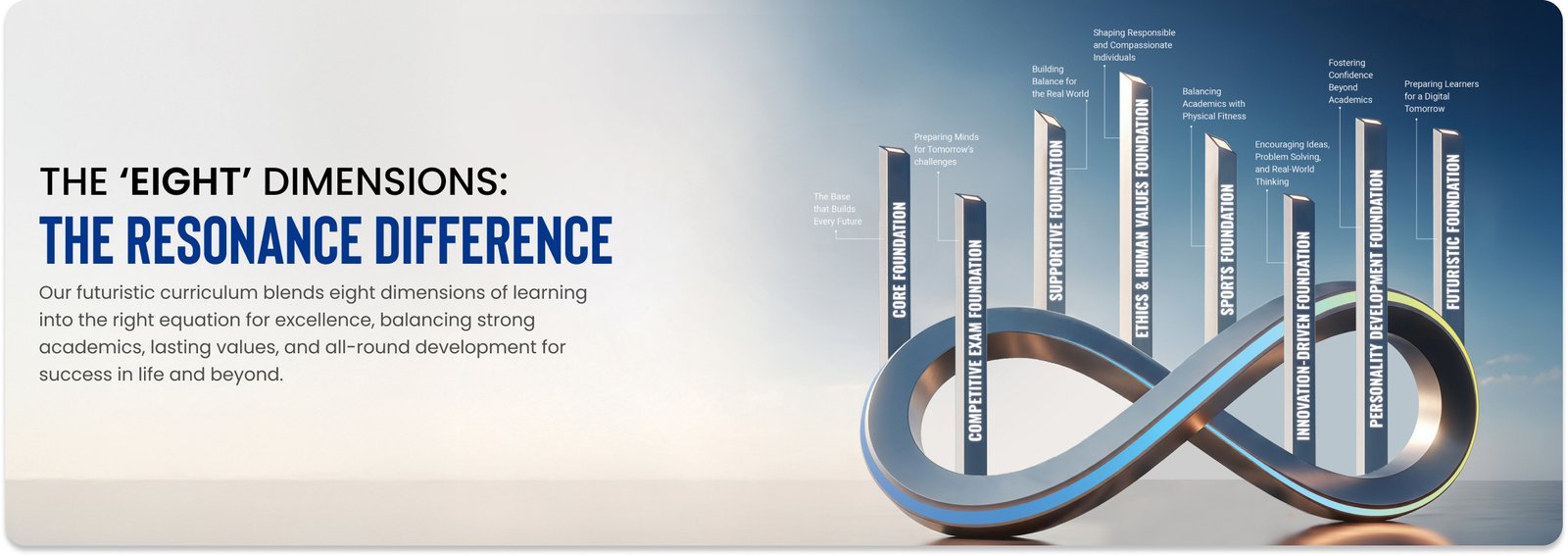

At Resonance, our futuristic curriculum goes beyond textbooks. The Reso Infinite Equation blends eight dimensions of learning into a seamless balance of knowledge, character, creativity, and care.
From strong academic rigour and depth to values that last a lifetime, these eight foundations form the right equation for excellence. They nurture learners prepared not only for competitive success but also for the challenges of life.
1. CORE FOUNDATION
THE BASE THAT BUILDS EVERY FUTURE
Objective
The Core Foundation forms the backbone of a student’s academic journey. At the right age, students need to develop strong conceptual clarity rather than rote learning. This foundation focuses on building depth of understanding, logical thinking, and disciplined study habits across core subjects.
Subjects Covered
Languages, Mathematics, Physics, Chemistry, Biology, and Social Studies are taught in an integrated and age-appropriate manner to ensure balanced academic growth.
Learning Approach
Students learn through conceptual explanations, hands-on practice, and interactive classroom discussions that encourage curiosity and questioning.
Teaching Methodology
Teaching is driven by clear explanations, real-life applications, active participation, and regular assessments to track progress and close learning gaps.
Outcome
- Strong conceptual clarity in core academic subjects
- Disciplined study habits
- Disciplined and consistent study habits
- Improved analytical and logical thinking
- Better academic performance and confidence
- Ability to apply knowledge to real-world situations

2. SUPPORTIVE FOUNDATION
BUILDING BALANCE FOR THE REAL WORLD
Objective
The Supportive Foundation strengthens the academic base by nurturing mental agility,
creativity, and emotional balance. It supports students beyond textbooks, enabling
them to think independently and manage academic pressure effectively.
Subjects Covered
Mental Ability, General Knowledge, and Art & Craft form the core of this foundation.
Learning Approach
Learning focuses on critical thinking, problem-solving, creativity, and emotional
regulation through structured and engaging activities.
Teaching Methodology
Teachers encourage independent learning while providing structured guidance and
continuous feedback to ensure holistic development.
Outcome
- Enhanced reasoning, critical thinking, and problem-solving skills
- Improved emotional stability and self-awareness
- Broader general knowledge and awareness
- Increased creativity and imagination
- Strong foundation for independent learning

3. COMPETITIVE EXAM FOUNDATION
PREPARING MINDS FOR TOMORROW’S CHALLENGES
Objective
This foundation introduces students to competitive exam preparedness at the right stage,
gradually building exam temperament without undue pressure. The focus is on skill-building,
strategic thinking, and confidence.
Subjects Covered
Olympiads, JEE/NEET foundation modules, IEO, IMO, and ISO.
Target (State and National Level Exams)
Exams Targeted During the Classes:
NSO, VVM, NSTSE, NMTC, IMO, and other Olympiad exams
Targeted Exams in Higher Education:
JEE, NEET, SAT, BITSAT, NATA, CAT, CUET, CLAT, KVPY, IISER,
NJSER, UGEEE, ISJ, CMI, IISc, ICAR, IPMAT, etc.
Learning Approach
Students practice exam-pattern questions, take mock tests, and learn time management
through regular, application-based practice.
Teaching Methodology
Teachers use concept-first teaching, timed practice, mock tests, and personalized
feedback to improve performance and build exam confidence.
Outcome
- Early preparedness for competitive exams
- Improved speed, accuracy, and time management
- Strong exam temperament and reduced anxiety
- Strategic problem-solving skills
- Confidence to face competitive challenges

4. FUTURISTIC FOUNDATION
PREPARING LEARNERS FOR A DIGITAL TOMORROW
Objective
The Futuristic Foundation prepares students for a rapidly changing world by introducing
future-ready skills at an early age. It bridges the gap between traditional education
and emerging global needs.
Subjects Covered
Financial Literacy, Media Literacy, and Information and Communication Technology.
Learning Approach
Learning is hands-on, project-driven, and technology-enabled, exposing students to
real-world tools and emerging industries.
Teaching Methodology
Teaching is conducted through project-based learning, interactive workshops,
and expert-led sessions that emphasize practical application.
Outcome
- Strong digital and technological literacy
- Financial awareness and responsible decision-making
- Media awareness and critical consumption of information
- Exposure to future career pathways
- Adaptability to technological and societal changes

5. SPORTS FOUNDATION
BALANCING ACADEMICS WITH PHYSICAL FITNESS
Objective
The Sports Foundation ensures physical well-being and character development,
emphasizing the importance of balance between academics and physical activity.
Areas / Subjects Covered
Indoor games, outdoor games, physical fitness, teamwork, and self-defence.
Outdoor Games
Basketball, Volleyball, Throwball, Cricket, Tennis, Football, Athletics,
Kho-Kho, Kabaddi
Indoor Games
Table Tennis, Carroms, Chess, Aerobics
Self Defence
Karate, Taekwondo
Learning Approach
Students participate actively in sports, fitness routines, and team-based
activities that build endurance and cooperation.
Teaching Methodology
Coaches provide practical training through drills, games, one-on-one coaching,
and tournaments.
Outcome
- Improved physical fitness, strength, and stamina
- Strong teamwork and leadership qualities
- Discipline and sportsmanship
- Stress management and mental resilience
- Healthy academic–physical balance

6. ETHICS & HUMAN VALUES FOUNDATION
SHAPING RESPONSIBLE AND COMPASSIONATE INDIVIDUALS
Objective
This foundation focuses on character building and moral development, shaping students
into responsible, empathetic, and value-driven individuals.
Areas / Subjects Covered
Community service, mentoring sessions, and value education.
Learning Approach
Students learn through ethical discussions, community engagement, peer interaction,
reflective activities, and curated movies, followed by structured workbooks that deepen
understanding and reflection.
Teaching Methodology
Teaching includes debates, group projects, mentoring, guest sessions, guided
self-reflection, and movie-based pedagogy to reinforce values, empathy, and real-life
learning.
Outcome
- Strong moral values and ethical judgement
- Increased empathy and social responsibility
- Respect for diversity and society
- Responsible citizenship mindset
- Confidence in expressing values and opinions

7. PERSONALITY DEVELOPMENT FOUNDATION
FOSTERING CONFIDENCE BEYOND ACADEMICS
Objective
This foundation focuses on building confident, articulate, and emotionally intelligent
individuals prepared to engage with the world effectively.
Areas / Subjects Covered
Music & Dance, Speech & Drama, Soft Skills, and MUN sessions.
Learning Approach
Learning is experiential, encouraging public speaking, creative expression, leadership
roles, and collaborative discussions, supported by technology-enabled assessment tools
to track progress and enhance skill development.
Teaching Methodology
Teachers provide practical communication training, leadership camps, and peer-learning
opportunities, supported by global-standard language assessments conducted through
Words Worth, our knowledge partner, to strengthen language proficiency
and communication outcomes.
Outcome
- Strong communication and presentation skills
- Leadership and teamwork abilities
- Creative confidence and self-expression
- Emotional intelligence and interpersonal skills
- Readiness for public platforms and discussions

8. INNOVATION-DRIVEN FOUNDATION
ENCOURAGING IDEAS, PROBLEM SOLVING & REAL-WORLD THINKING
Objective
The Innovation-Driven Foundation nurtures curiosity, creativity, and an entrepreneurial
mindset, encouraging students to become problem-solvers and innovators.
Areas / Subjects Covered
Science and invention workshops, idea competitions, and entrepreneurship programs.
Learning Approach
Students engage in research-based projects, hands-on innovation challenges, and
collaborative problem-solving.
Teaching Methodology
Teaching emphasizes project-based learning, mentorship, industry collaboration,
and idea incubation.
Outcome
- Strong innovation and creative thinking mindset
- Practical problem-solving and research skills
- Early exposure to entrepreneurship
- Ability to ideate, prototype, and refine solutions
- Confidence to pursue original ideas and initiatives