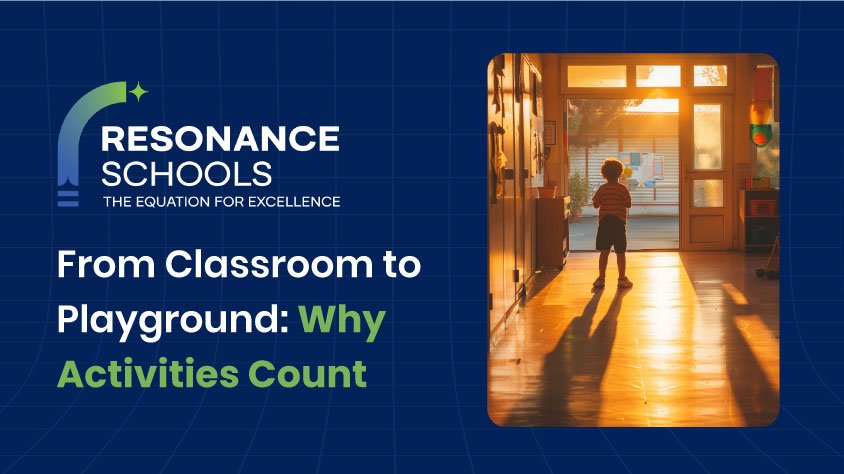
Where Learning Comes Alive: Beyond the Classroom Walls
There is a quiet truth about learning that timetables often forget: a child’s mind does not grow only at a desk. It grows in motion, in laughter, in curiosity, and in the small unscripted moments where discovery feels personal. It grows when questions are asked freely, when ideas are tried without fear of being wrong, and when experiences turn abstract lessons into lived understanding.
The journey from classroom to playground is not a break from learning it is a continuation of it, in a different language. One speaks in books and boards; the other speaks in movement, interaction, and imagination. Together, they shape not just what a child knows, but how a child thinks, feels, and approaches the world.
Learning Beyond the Bell
A worksheet can sharpen memory, but a game can sharpen judgement. When children play a sport, rehearse a performance, build a model, or collaborate on a project, they are learning to decide, adapt, and persevere. These are life skills disguised as activities.
The playground, the art room, the debate stage, the robotics lab these are spaces where theory meets experience. A child who measures a basketball throw understands angles differently. A child who plants a sapling understands patience differently. Activities give context to concepts, and context makes knowledge stay.
The Confidence Curve
Not every child raises a hand in class. Yet the same child may lead a team on the field or express boldly through music or art. Activities create alternate stages where different strengths shine. Confidence built here quietly travels back to academics into presentations, group work, and problem-solving.
When students experience small wins outside textbooks, they begin to trust their abilities. That self-belief often becomes the foundation for larger achievements later.
Social Intelligence in Action
Real life rarely offers multiple-choice questions. It offers people, perspectives, and unpredictable situations. Group activities teach negotiation, empathy, leadership, and respect for diversity of thought. Children learn to win gracefully, lose thoughtfully, and collaborate meaningfully.
These are not ‘extra” lessons. They are essential lessons simply taught without a chalkboard.
Balance Creates Better Learners
A well-engaged child is a better learner than a constantly pressured one. Physical movement improves focus. Creative activities reduce stress. Structured recreation builds discipline. When schools value balance, students do not feel torn between fun and responsibility they learn that both can coexist.
The goal is not to fill every hour with activity, but to design experiences that refresh the mind and stretch potential.
Preparing for a Larger World
The future values adaptability as much as accuracy. Careers evolve, industries change, and new challenges appear. Children who grow up exploring varied activities develop flexible thinking. They become comfortable trying, failing, and trying again.
In many ways, the playground is a rehearsal for life: dynamic, social, occasionally competitive, and always full of learning.
In the end, education is not only about how much a child knows, but how fully a child grows. When classrooms and playgrounds work together, learning becomes whole.