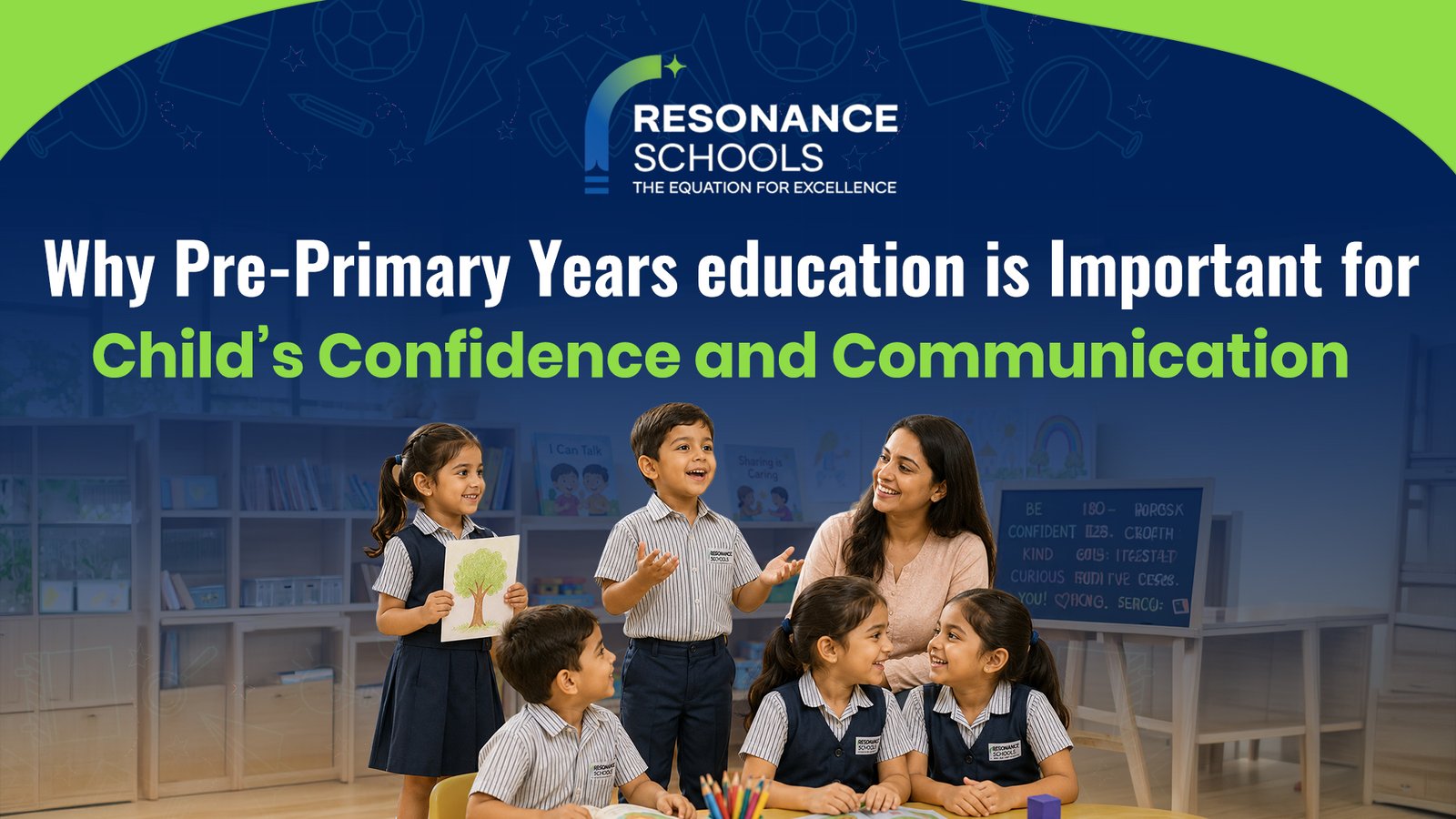
Why Pre-Primary Years education is Important for Child’s Confidence and Communication
Children's early years are frequently referred to as a 'window of opportunity', meaning that the brain is most likely to learn and develop during this time. We have learnt that pre-primary education is not only a preparation for ‘real school' but also an important period that lays the foundation of personality. Our Resonance Schools ROOT Framework is devoted to the specific issue of building confidence in children and building early communication skills: every child begins their education in a secure and curious way.
Constructing confidence by guided exploration
A sense of trust in a young child is fostered when they can explore, make mistakes and express themselves. Through guided exploration and a culture of ‘One-Team Learning' this is supported through our ROOT framework. From the first day, social interaction is encouraged in our classrooms. Children learn to interact well with others, share their ideas and feelings and show empathy through taking part in group activities, circle time and collaborative play.
So, we think independence is a major contributor to confidence. To encourage this, small manageable tasks are set such as colour choices for a drawing, where the student is able to move away from the 'fitting in' and take the step into imaginative thinking. A child who discovers that his ideas and choices are valued will have a growing sense of self-esteem and thus become a "Happy and Confident Learner.”
Mastering Communication Skills:
Through Phonics and Storytelling is a new series of books. Mastering Communication Skills through Phonics and Storytelling is a new series of books.
All future learning is grounded in communication. In our PP1 PP2 curriculum, we are going beyond repetition and encouraging children to develop their early communication skills by using phonics and storytelling. We embed phonics exposure into our daily routine allowing children to develop a solid phonetic foundation which is critical in developing early literacy and language confidence.
Storytelling and rhymes don't have to be fun, they are great ways to develop listening skills and vocabulary. Children develop skills to express their emotions and thoughts clearly as they move and engage in interactive sessions. Through this emphasis on communication they will be prepared for the more formal demands of primary school.
The importance of play and active learning.
A joyful learning environment is one where a child is physically active. Outdoor and active learning is a key element of our framework, which includes PE, yoga sessions, dance and movement games. These activities are not only for developing physical coordination but also provide an opportunity for social interaction and teamwork. Children learn to communicate effectively with each other, toward a common objective while playing together, deepening their interpersonal skills.
A Foundation Rooted in Readiness
This ultimately is a readiness agenda which is both academic and emotional, the agenda of pre-primary education at Resonance. Children are helped to feel safe in their environment and have a comfortable timetable through our structured Nursery PP1 PP2 learning system, which includes times for assembly, snack breaks and self-care habits. Confidence in early literacy and numeracy skills is established at this point, and students are given the chance to study and develop.
Finding the right equation is the key to excellence and the starting point is the pre-primary years. At every stage, Resonance Schools help children become effective global citizens, prepared to dazzle on any stage. Give your child a head start. Become a member of Resonance Schools now.
Frequently Asked Questions
Find answers to common questions about Resonance Schools